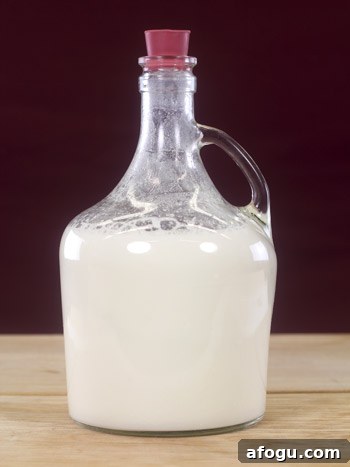
Traditional Clabber | Bainne Clábair
Clabber, also known as bainne clábair or bonny clabber, is a naturally soured, thickened milk traditionally used in Scotland and Northern Ireland for baking, cooking and drinking. The name derives from the Scots Gaelic words “bainne” (milk) and “clábair” (sour milk). Clabber works well in breads, scones and as a tangy dairy for drinking or as a base for yoghurt-like preparations. In many recipes it can be used as a substitute for buttermilk.
What is clabber? Clabber forms when raw, unpasteurised milk or traditional buttermilk is left at room temperature and naturally sours and thickens. Lactic acid bacteria already present in fresh milk convert lactose to lactic acid, causing the milk to curdle and develop a yoghurt-like texture and a pleasantly sharp, sour flavour. For clabber to form safely, the milk must contain the good lactic-acid bacteria rather than harmful microbes.
Most modern supermarket milk is pasteurised, a heat process that eliminates both beneficial and harmful bacteria. When using pasteurised milk you need to reintroduce the beneficial cultures. Cultured buttermilk from the shop, which contains live lactic-acid bacteria, can act as a starter culture to initiate clabber. Note that “cultured” buttermilk is different from traditional buttermilk obtained as a byproduct of churning butter and is not the same as acidified milk made with vinegar or lemon.
If you have access to fresh, unpasteurised milk and understand the associated food-safety considerations, you can use it directly to make clabber without a commercial starter. Traditional buttermilk produced by making butter from unpasteurised double (heavy) cream can also serve as an effective starting culture.
Clabber | Bainne Clábair Recipe
To establish a clabber starter, add a small proportion of cultured buttermilk to pasteurised milk. After successive refreshes the milk will clabber more quickly, eventually taking as little as 24 hours.
Recipe Ingredients:
- 240 ml shop-bought cultured buttermilk (confirm it is cultured)
- Three portions of 240 ml full-fat milk (whole milk)
- 1 litre full-fat milk (whole milk)
Recipe Method:
Making the clabber starter: Sterilise and rinse a clean glass jar or a wide-neck bottle that seals (about 600 ml capacity). Combine 240 ml fresh whole milk with 240 ml cultured buttermilk, seal and shake gently to mix. Leave the jar at room temperature until the mixture sours and thickens to a yoghurt-like consistency. This first fermentation commonly takes several days.
When the mixture has thickened, shake it, discard (or use) half of the contents and retain the remaining half as starter. Add 240 ml fresh milk to the jar, seal and shake, then leave at room temperature again until it clabbers. Repeat once more: after clabbering, keep half, add another 240 ml fresh milk, and after this cycle the mixture should reliably clabber within 24 hours. Taste a small amount to confirm it is tart and free of off-flavours; it should be pleasantly acidic, not bitter. This established culture is your clabber starter or inoculum.
Making clabber in larger quantity: To make just over a litre of clabber, pour approximately 200 ml of the clabber starter into a sterilised 1.2 litre jar that seals. Add 1 litre of fresh whole milk, seal and shake to combine. Leave at room temperature for two or three days until it thickens and sours. Once clabbered, refrigerate and use as needed.
The remaining clabber starter can be stored in the fridge and refreshed regularly to maintain its activity. If a starter is left unrefreshed for more than about four weeks it may lose its viability and fail to inoculate new milk effectively. To keep the starter active, feed it periodically with fresh milk.
Note: If a harmless surface mould develops on the inner walls of an unused clabber jar after several weeks, it can be removed. This mould is related to fungi that grow on cheeses and is not typically dangerous. Discard or remove the mould, clean the jar thoroughly, and the clabber itself can still be used for baking if the product beneath shows no other signs of spoilage.